Quality and traceability
Here you can see how we check and document every lot: from the selection of the manufacturer through analysis and release to handover. This makes every delivery traceable from the manufacturer’s lot through to you.
What is evidenced here
We trade exclusively in non-GM soybean cake. As drop-shipment traders, we deliver fresh and directly from the manufacturer, without intermediate storage. We therefore document the route of the goods: which manufacturer a lot came from, what was released before loading and handover, which sample was drawn and which quality certificate belongs to it.
Traceability is not a marketing term here but a duty under Art. 18 of Reg. (EC) No 178/2002. Feed business operators must be able to assign every delivery one step back and one step forward. We keep the information for each batch ready so that it is available in both directions within 4 hours. To this end, we record every lot in our own ERP system: contract, quality certificate, analyses, shipping documents and release note are filed there digitally per lot, backed up regularly and kept for at least three years.
We are certified to GMP+ FSA and GMP+ FRA (GMP065911) and registered as a feed business operator under Reg. (EC) No 183/2005 (decision of 20 October 2026). You will find all records on the Evidence page.
Supplier selection and origin
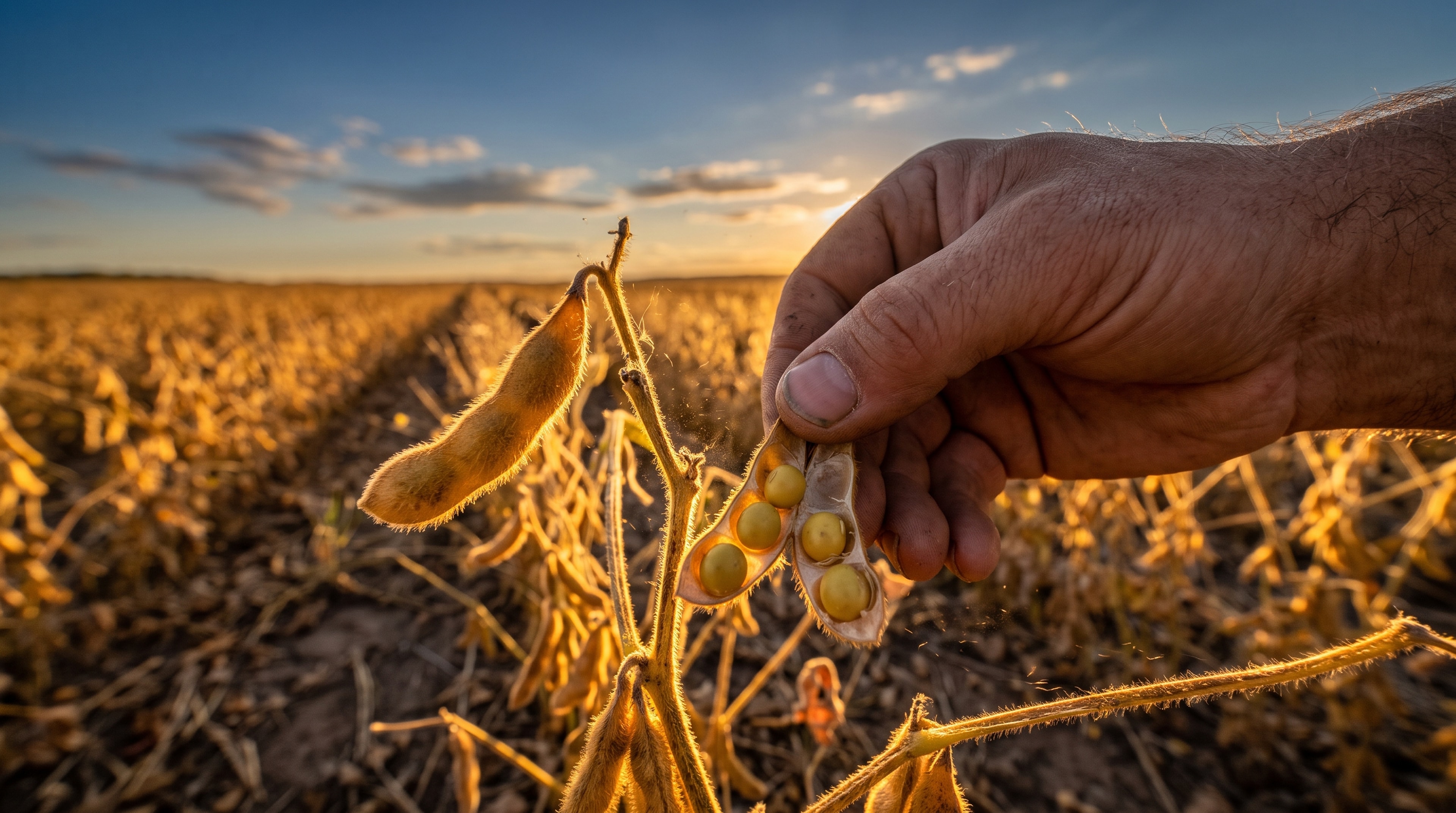
Our soybean cake originates in Ukraine. The manufacturer presses it mechanically, without solvent.
We buy only from a manufacturer that has been examined and approved. Beforehand, we check its GMP+ certificates with a matching scope, its GMP+ FRA “GMO controlled” status, its registration in the country of origin and the laboratories that perform the analyses. Before every purchase, we check the certificates again in the GMP+ database. We assess every partner once a year.
No lot is released without a quality certificate for the lot and an agreed specification.
The Ukrainian origin is stated for each delivery on the delivery note and in the EUR.1 proof of origin.
Checking and releasing every lot
Because the goods go directly from the manufacturer to you, we carry out checks before loading and before handover on the basis of the documents. Without our release, nothing is loaded or handed over.
Supplier approval
We buy only from an approved manufacturer. Before approval and before every purchase, we check its GMP+ certificates in the GMP+ database and file the evidence. We assess every partner once a year.
Analysis and documents before loading
Before every loading, our management checks the lot’s quality certificate against the specification, together with the analyses for salmonella and mycotoxins and the GMO analysis (PCR) from a VLOG-recognised laboratory, all from the lot’s pre-loading sample, as well as the sampling record of the pre-loading sample and the validity of the certificates. If an analysis is missing or a value lies outside the limits, the lot is not released.
Sampling and retained samples at the manufacturer
Each lot is sampled twice. Before loading, the manufacturer draws a pre-loading sample from which the analyses are made. At loading, the manufacturer draws two sealed retained samples of 1 kg each. The manufacturer keeps one for at least 12 months; the other is given to you. The manufacturer records the loading in the loading record.
Loading and transport
The goods are delivered in bulk, around 25 tonnes per lot. We commission the transport, and only from an approved haulier.
Release for handover
Before handover, we check that the documents are complete. On handover, you check the accompanying documents once more.
Every release is recorded on the batch release note with name and date. One batch is one journey.
Sampling
Any statement about a lot is only as good as the sample it comes from. A lot comprises around 25 tonnes. A quantity like this is not homogeneous: moisture, fines and hull content are distributed unevenly, and with cake the residual oil content as well. A handful from the top layer therefore describes the top layer, not the lot.
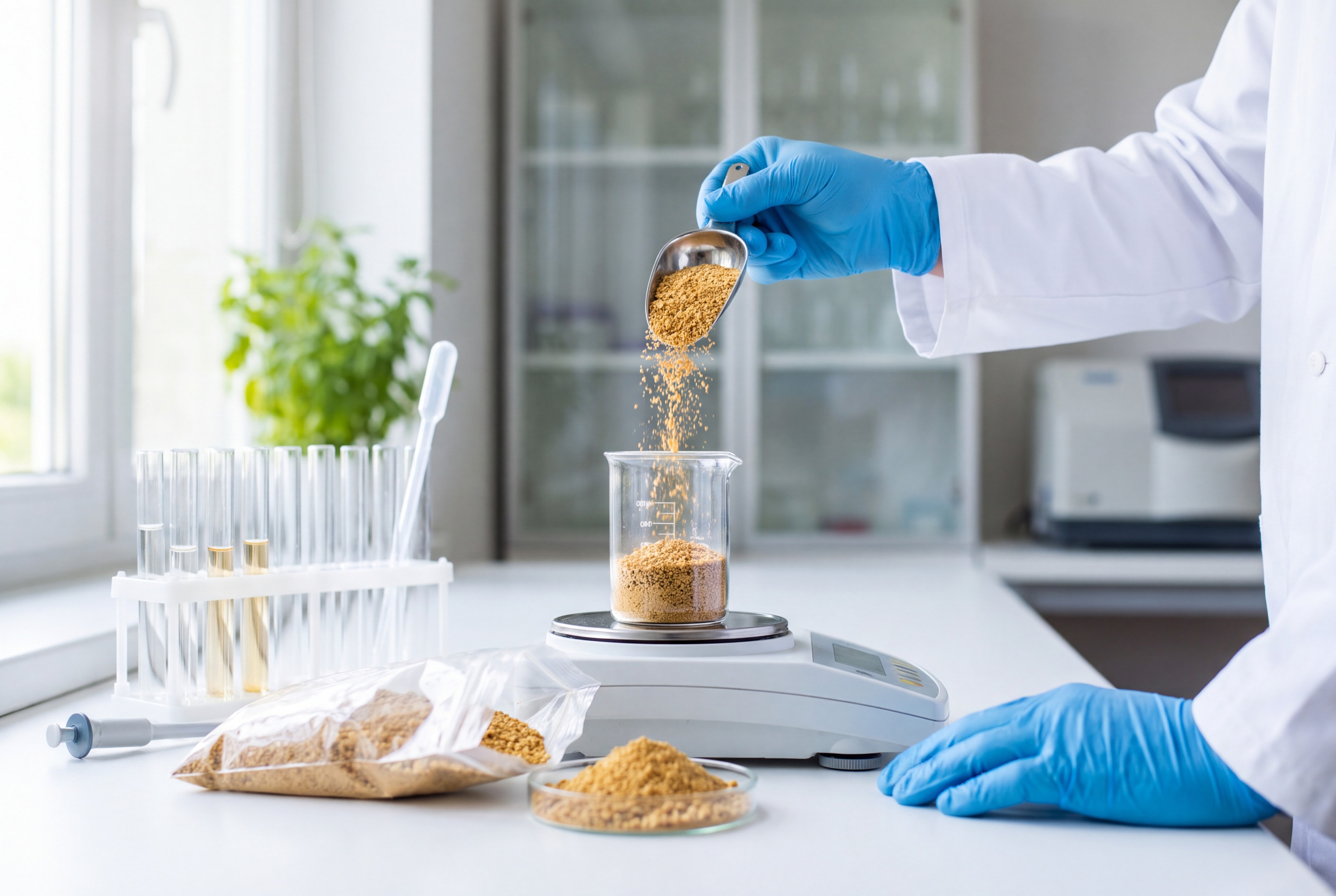
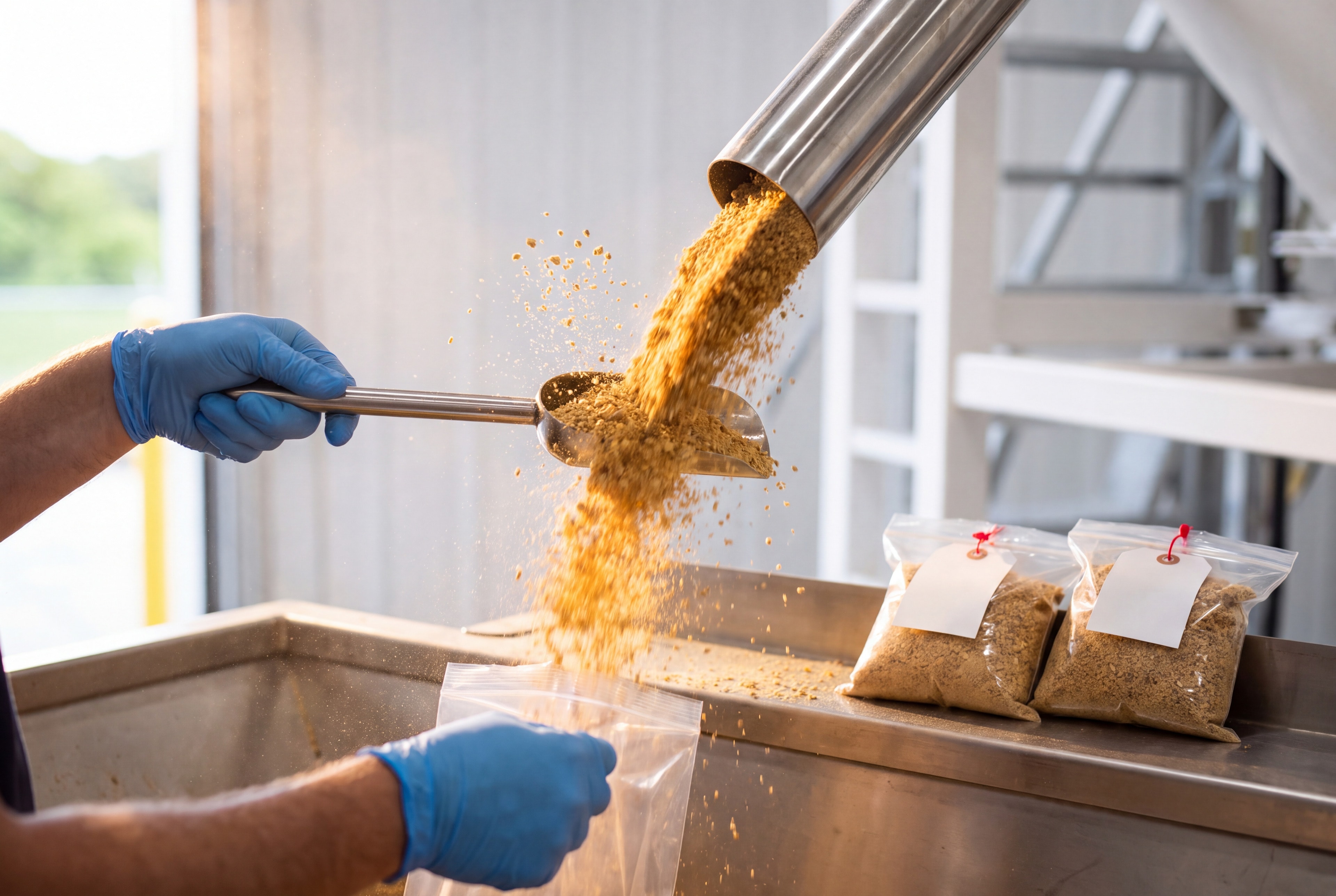
Each lot is sampled twice. Before loading, the manufacturer draws the pre-loading sample: incremental samples are taken spread across the entire lot and combined into a composite sample. The quality certificate and the analyses for salmonella, mycotoxins and GMOs (PCR) are made from it. At loading, the manufacturer draws a second composite sample across the entire load. The two sealed retained samples come from it.
The technical framework is GMP+ TS1.6 and Reg. (EC) No 152/2009, which lays down the methods of sampling for the official control of feed.
The manufacturer records the pre-loading sample. The analyses and the sampling record must be available before we release the lot for loading. Without this record, even a correctly drawn sample can no longer be assigned later on.
Retained samples
A retained sample is a safeguard for both sides. If a lot only attracts attention at the compound feed mill, loading lies in the past and the goods have often already been processed. Without a retained sample it is then one account against another. With a retained sample, the condition at the time of loading can be established after the event.
For each lot, the manufacturer draws two sealed retained samples of 1 kg each at loading. They are labelled with batch, lot and date. The manufacturer keeps one sample for at least 12 months; you receive the second.
In the event of a complaint the retained sample is drawn on. We can arrange a further analysis from it at any time. If two GMO results differ, a third analysis from the sealed sample in a VLOG-recognised laboratory other than the manufacturer’s decides. The result is assessed together with the certificate of analysis, the manufacturer’s sampling record and the release note.

Certificates of analysis
Every lot comes with a quality certificate from the manufacturer stating the figures for that particular lot. In addition, each lot has analyses for salmonella and mycotoxins and a GMO analysis (PCR) from a VLOG-recognised laboratory. Pesticides, dioxins and heavy metals are tested according to the sampling plan at least six times a year.
Soybean cake specification (limits, goods as delivered, ash in the dry matter)
| Parameter | Value | Unit | Explanation |
|---|---|---|---|
| Crude protein | Valuemin. 48% | % | Proportion of nitrogenous compounds. The decisive figure for the protein value of the product. |
| Crude fat | Value6 to 10% | % | Oil remaining after pressing. Determines energy content and storage behaviour. |
| Crude fibre | Valuemax. 7% | % | Proportion of poorly digestible structural matter, largely from the hulls. |
| Hydrochloric acid-insoluble ash | Valuemax. 1% in DM | % in DM | Mineral fraction, mostly sand and soil. Elevated values indicate contamination. |
| Moisture | Valuemax. 12% | % | Water content. Determines storage stability and the risk of mould. |
| Urease activity | Valuemax. 0.3ΔpH | ΔpH | A measure of heat treatment. A value that is too high indicates insufficient toasting. Over-toasting cannot be reliably identified from it. |
Analytical values are lot-specific. The specification is agreed in the contract; the quality certificate documents the values of the delivered lot.
- Below
- No lower limit agreed. A low value shows that the heating was sufficient. Over-toasting cannot be reliably identified from it; other parameters such as KOH solubility or PDI serve that purpose.
- Above 0.3 ΔpH
- Insufficient toasting. Trypsin inhibitors are still active and impede protein digestion. Young animals are sensitive to this.
The corridor applies to the product, the value to the lot. The specification is agreed in the contract; the quality certificate documents the values of the delivered lot.
The specification is agreed in the contract; the quality certificate documents the values of the delivered lot. The table gives the agreed limits of the specification, not the values of a lot. It is not a warranty for an individual delivery.
All certificates of analysis are assigned to the batch in the batch file. The route from the delivery back to the analysis, to the sampling record and to the retained sample is thus traceable in both directions. You receive the certificates for your lot on request.
From the field to the trough
The chain has seven stations. We are ourselves responsible for four of them: release for loading, the transport order, release for handover and the handover documents. Growing, processing and loading are the responsibility of the growers and the manufacturer. Each station therefore states who stands behind the information.
- 01
Who states this: Statement of the upstream supplier
Growing
Farms in Ukraine grow the soybeans and harvest them. The assignment reaches back as far as the manufacturer documents it.
- 02
Who states this: Statement of the processing plant
Processing at the plant
At the manufacturer’s plant, the oil is pressed out mechanically, without solvent. The heat treatment is checked via urease activity. This is where the lot arises: what counts is the lot number in the manufacturer’s quality certificate.
- 03
Who states this: Commitment of this house
Procurement and release for loading
We contract with the approved manufacturer and set the delivery terms. Before every loading we check the lot’s quality certificate, analyses, PCR and certificates. Without this release, nothing is loaded.
- 04
Who states this: Statement of the processing plant
Loading at the manufacturer
The goods are loaded in bulk, around 25 tonnes per lot. During loading, the manufacturer draws the two sealed retained samples. The loading record and the sampling record of the pre-loading sample form part of the lot documentation.
- 05
Who states this: Commitment of this house
Transport
We commission the transport from an approved haulier.
- 06
Who states this: Commitment of this house
Release for handover
Before handover, we check that the documents are complete. Only then is the lot handed over to you.
- 07
Who states this: Commitment of this house
Handover to the customer
You check the accompanying documents on handover and receive the delivery note and the second retained sample. Via the batch and the manufacturer’s lot, the route remains traceable in both directions. Use and application rest with you.
The note names who states the information, not who owns the station. Where it reads “Statement of the upstream supplier” or “Statement of the processing plant”, the information comes from that business. We pass it on and check it for completeness. Our statutory duties of inspection and care as a feed business operator remain unaffected.
Non-GM is not organic
The two terms are often lumped together in conversation. They describe different things. That is why the difference is spelled out here.
Non-GM
Legal framework
For the feed: not subject to labelling under Reg. (EC) No 1829/2003, traded with GMP+ FRA “GMO controlled” status. You base your own “Ohne Gentechnik” claim on this, under the EG-Gentechnik-Durchführungsgesetz (the German act implementing EU genetic engineering law) and the VLOG standard.
Concerns
Solely the GM status of the raw material.
- The soybeans come from non-genetically-modified breeding.
- The evidence rests on continuous documentation of the supply chain and on the separation of goods flows all the way to the customer.
- For each lot there is a GMO analysis (PCR) from a VLOG-recognised laboratory. The lot is released only if every event and the total are below 0.1 %.
Not covered
Fertilisation, crop protection, crop rotation and all other growing conditions. The status says nothing about them.
Organic
Legal framework
Reg. (EU) 2018/848 on organic production, with approved control bodies and mandatory certification.
Concerns
The entire method of production, not only the GM status.
- No mineral nitrogen fertiliser, in principle no chemically synthesised plant protection products.
- Requirements on crop rotation and soil management.
- Annual inspection by an approved control body, with its own labelling and code number.
Not covered
The status attaches to the business: trading, storage and handling must be certified as well, otherwise the goods lose their organic character.
Genetically modified organisms are prohibited in organic production. “Ohne Gentechnik” is nevertheless a separate claim with its own rules and evidence; organic goods do not carry it automatically. Conversely, non-GM goods are not an organic product and may not be described as one.
The products traded are non-GM goods. Organic certification is not held and organic goods are not offered. GM status is evidenced lot by lot through the manufacturer’s delivery documents with GMP+ FRA “GMO controlled” status and a PCR analysis. We are certified to GMP+ FSA with GMP+ FRA “GMO controlled” (GMP065911).
What is not stated here yet
We are newly founded. Most points have been settled in the procedures and are described above. The following points are still open. They will be added once they are firmly established — not filled with figures that later turn out to be untenable.
Supplier selection and origin
- Signed supply contract with the manufacturer (covering sampling, retained samples and the loading record)
Sampling
- Number of incremental samples per lot
- Division procedure for the composite sample
Documents relating to a lot
For a lot enquired about, the quality certificate, the PCR report, the manufacturer’s sampling record and the release note are provided on request. The specification is agreed in the contract; the quality certificate documents the values of the delivered lot.