
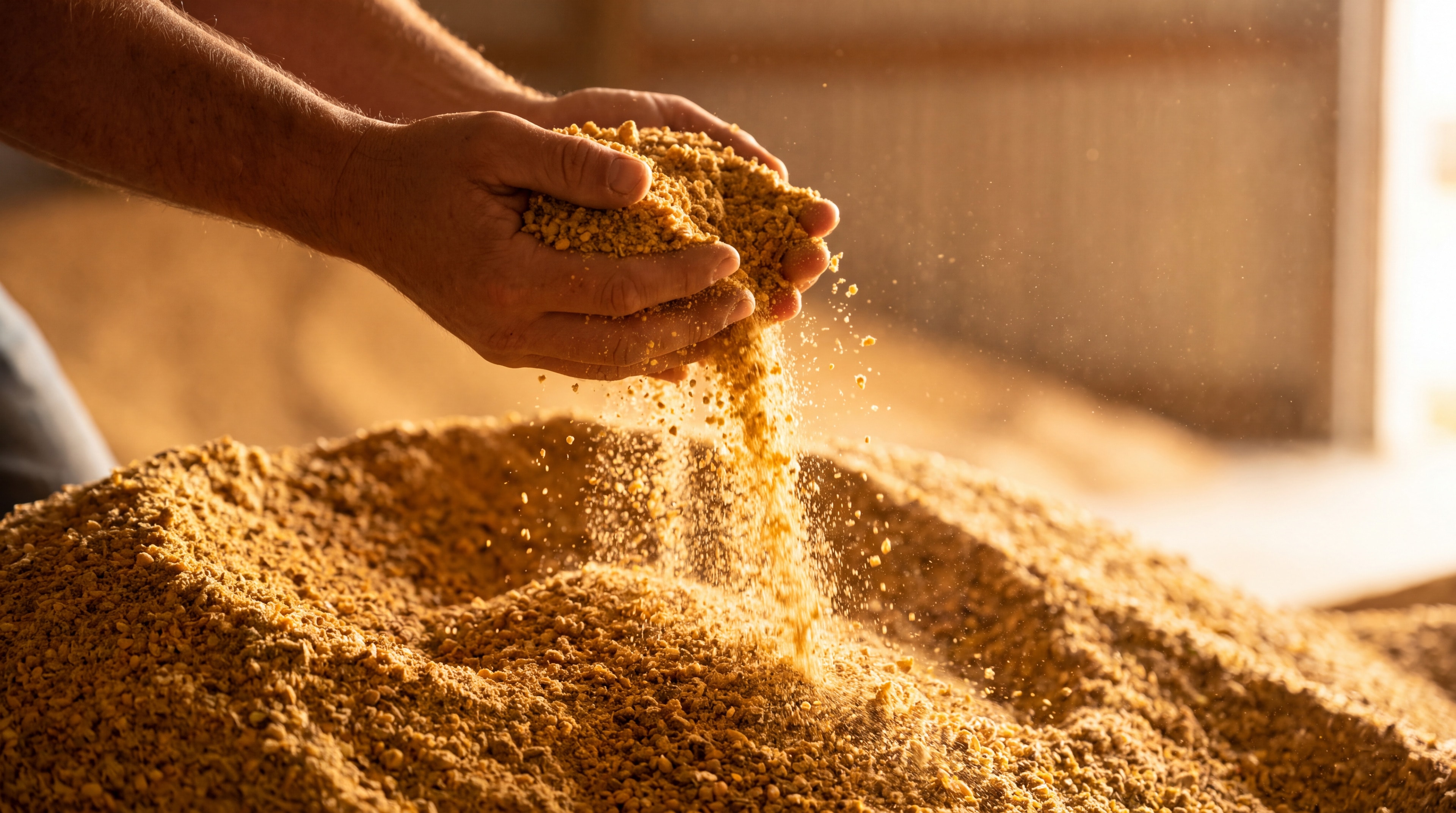
Soybean cake
Mechanically pressed, without solvent and non-GM. 48.11 % crude protein and 6.02 % crude fat (as delivered). Suitable for cattle, pigs and poultry within the inclusion limits for each species.
The product
Soybean cake, also called expeller, is produced when the oil is pressed out of the soybean purely mechanically, without solvent. Part of the oil remains in the cake, which makes it richer in energy than soybean meal.
Soya oil consists predominantly of unsaturated fatty acids, above all linoleic acid. This is why inclusion limits apply for each species. They are given with their source further down.
The heat is generated by the pressing itself and acts like toasting. To make sure it is sufficient, every lot is tested for urease activity and trypsin inhibitors. Both values are stated in the quality certificate.
Manufacturing process
Mechanical oil pressing (expeller process) without solvent. The heat is generated by the pressing itself.
Technical designation
Soybean cake (expeller), mechanically pressed, non-GM, GMP+ code 2.187

Parameters from two sample lots
Nutritional values from test report no. 10944/1/26 of an accredited laboratory (ISO/IEC 17025) dated 6 October 2026, as delivered. You will find the value in the dry matter in the explanation. The remaining values are taken from the manufacturer’s quality certificate no. 10359. The two documents relate to two different lots; the values serve as an example. Analytical values apply per lot. The specification is agreed in the contract; the quality certificate documents the values of the delivered lot.
Parameters (test report no. 10944/1/26 and quality certificate no. 10359)
| Parameter | Value | Unit | Explanation |
|---|---|---|---|
| Crude protein | Value48.11% | % | Proportion of nitrogenous compounds; the decisive figure for protein value. As delivered; in the dry matter 52.1 %. |
| Crude fat | Value6.02% | % | As delivered; in the dry matter 6.5 %. The fat fraction is a key value for suitability by species. |
| Crude fibre | Value3.23% | % | Proportion of poorly digestible structural matter, largely from the hulls. As delivered; in the dry matter 3.5 %. |
| Moisture | Value7.74% | % | Moisture and volatile matter, calculated from the dry matter. Water content. Determines storage stability and the risk of mould. |
| Dry matter | Value92.26% | % | — |
| Hydrochloric acid-insoluble ash | Value0.1% in DM | % in DM | Mineral fraction that does not dissolve in hydrochloric acid, mainly sand and soil. Indicates contamination. |
| Urease activity | Value0.1ΔpH | ΔpH | A measure of heat treatment, stated as a pH difference. Deserving particular attention with cake: the heat input arises during pressing and can vary between lots. |
| Trypsin inhibitor activity (TIA) | Value2.5mg/g | mg/g | Direct measurement of the remaining trypsin inhibitors, which impede protein digestion. Complements urease activity. |
| Metallic contaminants | Value0.002% | % | Particles up to 2 mm. Particles over 2 mm: none present. |
| Foreign matter | Valuenone present | — | |
| Pest infestation | Valuenone detected | — | |
| Appearance | Valueground, yellow to light brown | Odour typical of soybean cake. | |
| Origin | ValueUkraine | Preferential origin Ukraine, evidenced by EUR.1 movement certificate. | |
| GM status | Valuenon-GM | Non-GMO goods. The manufacturer of the sample lot is certified to GMP+ FSA and GMP+ FRA (GMO controlled). Not to be confused with organic production. | |
| Form of delivery | Valuebulk | Bulk goods, around 25 t per lot. Form of delivery and procedure are agreed for each order. | |
| Minimum quantity | Valuearound 25 t per lot | — | |
| Storage life | Value3 months | Manufacturer’s figure from production. The fat fraction is prone to oxidative spoilage in warmth and on contact with oxygen. |
Analytical values are lot-specific. The specification is agreed in the contract; the quality certificate documents the values of the delivered lot.
What the limits mean
For the key parameters, we show what a value that is too high or too low means for feeding. Where our specification sets a limit, it is stated. It becomes binding with the contract.
Tolerance corridor · Crude fat Analysis value: 6.02 %
- Below 6 % as delivered
- Lower energy content. For ration formulation this is not a deficiency but a different starting point.
- Above 10 % as delivered
- In pigs and poultry the proportion of unsaturated fatty acids in body fat rises, which impairs fat quality. High-fat goods are also prone to oxidative spoilage in warmth and on contact with oxygen.
The corridor applies to the product, the value to the lot. The specification is agreed in the contract; the quality certificate documents the values of the delivered lot.
Tolerance corridor · Moisture Analysis value: 7.74 %
- Below
- Not critical for the goods themselves. Very dry material dusts more during handling and loses weight.
- Above 12 % as delivered
- Risk of mould formation, self-heating in store and spoilage. Storage life falls markedly; where mould develops, mycotoxins are an additional hazard.
The corridor applies to the product, the value to the lot. The specification is agreed in the contract; the quality certificate documents the values of the delivered lot.
To the table row „Urease activity“
Tolerance corridor · Urease activity Analysis value: 0.1 ΔpH
- Below
- No lower limit agreed. A low value shows that the heating was sufficient. Over-toasting cannot be reliably identified from it; other parameters such as KOH solubility or PDI serve that purpose.
- Above 0.3 ΔpH
- Insufficient toasting. Trypsin inhibitors are still active and impede protein digestion. Piglets and young poultry are particularly sensitive to this.
The corridor applies to the product, the value to the lot. The specification is agreed in the contract; the quality certificate documents the values of the delivered lot.
Suitability by species
The classification is based on feeding trials and specialist literature; the source is given under each species. The inclusion limits are guide values. Your feeding adviser formulates the ration on the basis of the analysis of the respective lot.
How to read the classification
The classification has three levels. It describes the customary field of use and is not an assessment of the goods.
- Suitable
The customary field of use for this product. The general requirements for lot analysis and ration formulation apply.
- Suitable with restrictions
Use is possible but tied to conditions. The restriction stated is part of the classification and is to be taken into account in ration formulation.
- Not suitable
Not intended for this species. The reason is given in the reasoning.
Species
Cattle
Classification
SuitableReasoning
In a feeding trial by the Bavarian State Research Center for Agriculture (LfL), soybean cake fully replaced soybean meal and rapeseed cake in the dairy ration (16 % of dry matter). Feed intake, milk yield and milk composition remained unchanged. Soybean cake can serve as the sole protein feed for dairy cows and beef cattle.
Restriction
Recommended up to 4 kg per dairy cow and day, up to 2 kg per beef animal. The fat content of the total ration should not exceed 4 to 5 % of dry matter.
Source: LfL Bayern, Ettle u. a. (2010): Zum Einsatz von Sojakuchen in der Milchviehfütterung; FiBL-Fütterungsfibel, Bellof: Heimische Sojaprodukte in der Fütterung landwirtschaftlicher Nutztiere
Species
Pigs
Classification
SuitableReasoning
Toasted soybean cake is a full-value protein source for pigs. In piglet rearing it fully replaced soybean meal without affecting daily gain or feed conversion.
Restriction
Recommended up to 20 % of the complete feed for piglets, sows and fattening pigs up to 70 kg, up to 15 % in the finishing phase. The ration must be balanced for lysine and methionine.
Source: FiBL-Fütterungsfibel, Bellof: Heimische Sojaprodukte in der Fütterung landwirtschaftlicher Nutztiere; Puntigam u. a. (2021): Heimischer Sojakuchen in der Ferkelaufzucht
Species
Poultry
Classification
SuitableReasoning
For poultry, soybean cake is one of the preferred protein feeds. With a ration matched to requirements, feeding trials showed no loss of performance.
Restriction
Recommended up to 20 % of the complete feed for laying hens and up to 25 % for broilers. Soy protein is low in methionine; the ration must be supplemented accordingly. Adequate heat treatment is a prerequisite, evidenced by urease activity and trypsin inhibitor in the lot’s quality certificate.
Source: FiBL-Fütterungsfibel, Bellof: Heimische Sojaprodukte in der Fütterung landwirtschaftlicher Nutztiere
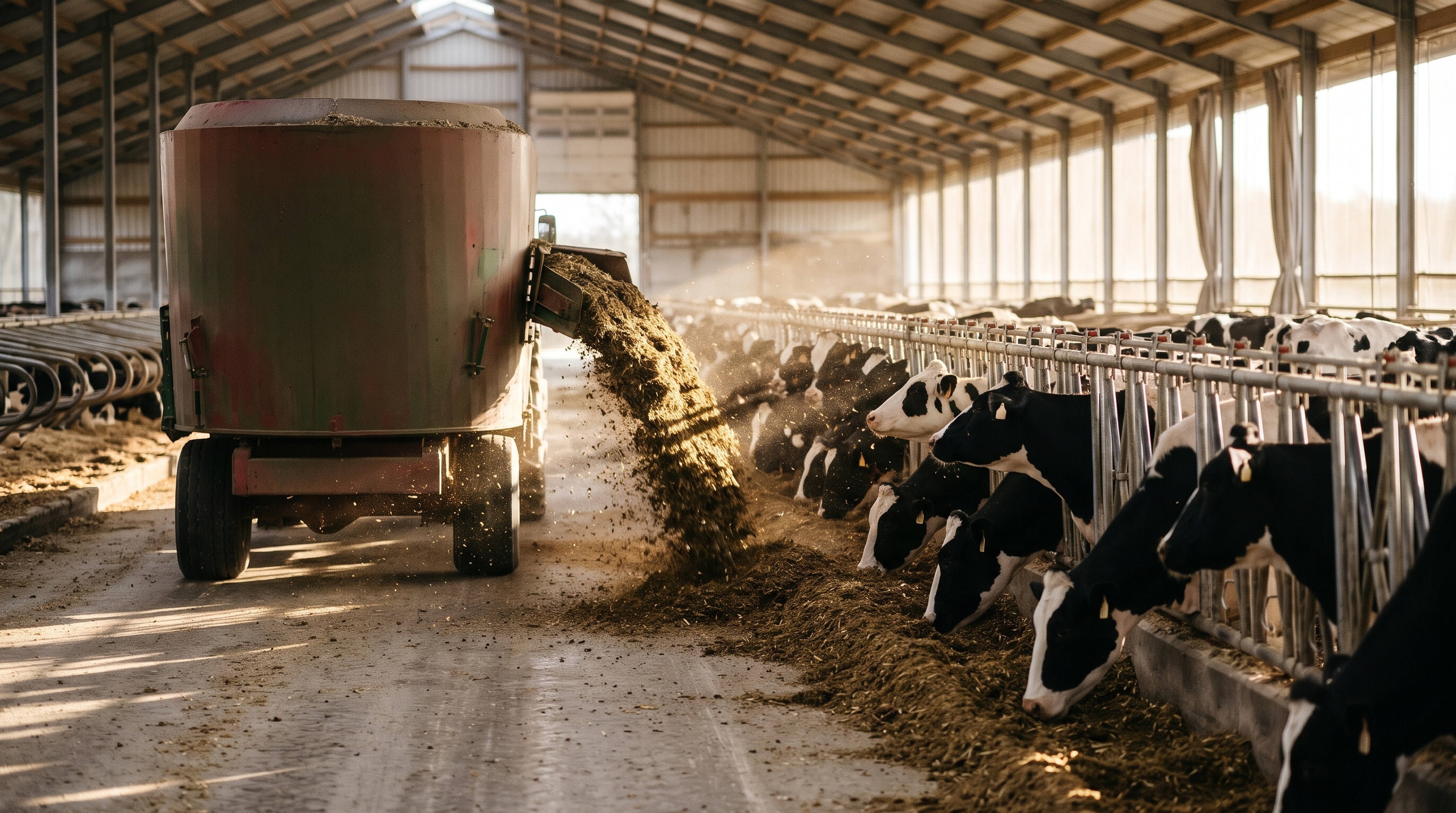
Who our soybean cake is intended for
For compound feed mills, agricultural merchants and livestock farms in the EU that can take in around 25 t of bulk goods.
How much soybean cake goes into the ration depends on species, performance and the other components. Your feeding adviser will determine this.
How the goods reach you
- 01
Bulk goods
- 02
Form of delivery and procedure agreed for each order
- 03
Delivery unit around 25 t per lot, larger quantities by agreement
What is binding are the terms agreed in the contract.
Enquiry about this product
Tell us the quantity and the country and postcode of the place of delivery, and if you like the desired delivery period. We will get back to you with availability, date and price.